What Business Leaders Need To Know About AI
AI is already in your business
Someone in your team has probably pasted a document into a chatbot this week. It saved them twenty minutes. Nobody asked IT.
That's not a disaster, it's proof AI is useful. But it makes AI security a today problem, not a future one.
The good news? You don't have to choose between innovation and protection. You need clear ownership, sensible rules and controls that match the risk. Here's what that looks like in practice.
Adoption is racing ahead of readiness
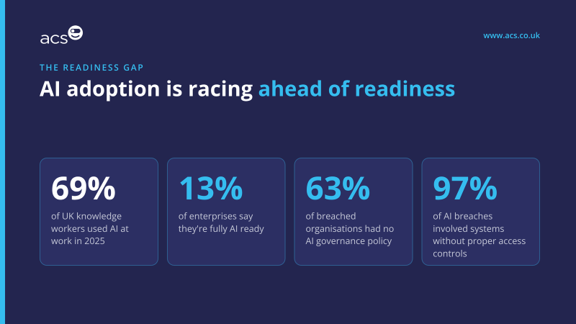
69% of UK knowledge workers used AI at work in 2025. Only 13% of enterprises say they're fully AI ready. That gap is where the risk lives. But it's not all doom. 90% of AI users say it saves them time, and 85% say it helps them focus on important work. The value is real, it just needs guardrails. And the stakes are rising: the average cost of a breach went up by $200K in the last year.
Shadow AI: the risk you can't see
Shadow AI is any AI tool used without approval or oversight: public chatbots, meeting bots, browser extensions or a team's own subscription.
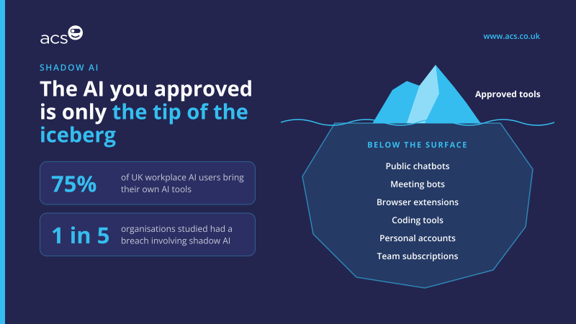
75% of UK workplace AI users bring their own tools, and one in five organisations studied has had a breach involving shadow AI.
The risk is what goes into the prompt. Customer details, contracts and financial records can leave your business in seconds.
In 2023, Samsung restricted staff use of generative AI after an engineer reportedly uploaded sensitive source code to ChatGPT. It wasn't malicious, just someone looking for help with their work.
Banning AI rarely works. It just pushes it out of sight. Give people approved tools, clear rules and an easy way to request new ones. Even with Microsoft Copilot, tidy up file permissions first: it can surface anything a user can already access.
AI agents: from answering to acting
Agents don't just answer questions. They update records, send messages and prepare payments, so a mistake becomes an action rather than a draft. Before you deploy one, ask:
1. What can it see?
2. What can it change?
3. Which decisions stay with a person?
4. How will you switch it off?
Give every agent its own identity rather than a shared account, so you can see what it did and remove its access cleanly. And watch out for prompt injection: instructions hidden in an email, document or web page that try to redirect the agent. Treat connected content as untrusted, even when it comes from a familiar system.
How criminals are using AI
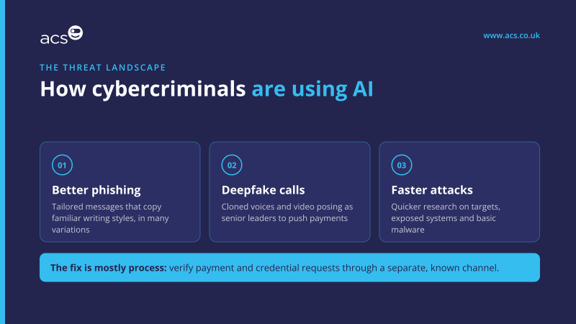
AI makes old tricks faster and more convincing. In 2024, an Arup employee was fooled by deepfake video of senior executives into transferring millions. No systems were hacked.
• Phishing that looks right. Messages can mention a real project, copy a colleague's writing style and arrive in hundreds of variations.
• Faster groundwork. The NCSC says AI is already helping attackers research targets, find vulnerabilities and write basic malware.
• Growing reach. 16% of breaches now involve attackers using AI tools.
The fix is mostly process. Verify any request involving money, passwords or bank details through a separate, known channel. Keep the basics strong too: patching, MFA, tested backups and staff training.
Your AI security checklist
A secure AI strategy doesn’t need to be overly complicated. It needs a simple, repeatable way to decide which tools to use, what each one can access and how you’ll keep an eye on things. These six areas are the best place to start.
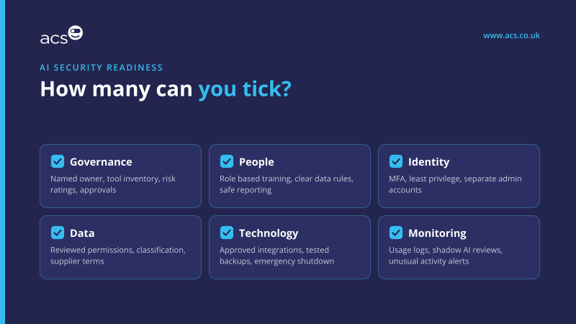
• Governance: someone owns AI, knows what's in use and signs off new tools
• People: staff know what data never goes into AI and how to report mistakes without fear of blame
• Identity: strong logins, and people and tools only get the access they actually need
• Data: permissions checked before AI is connected, and supplier terms read properly
• Technology: approved connections only, tested backups and a quick way to switch AI off
• Monitoring: AI use is logged, shadow AI is reviewed and unusual activity is flagged
Start small with one low risk pilot and clear success measures, then expand. Review your controls whenever a tool, agent or supplier's terms change.
How ACS can help
Most small and medium businesses don't have a spare security specialist to assess every new AI tool. That's where a managed IT partner earns its keep. We can help with:
• AI readiness assessment: where AI can add value, and where the gaps are
• Security reviews: permissions, devices, backup and monitoring checked before AI goes near sensitive data
• Governance: practical acceptable use guidance and the right level of oversight for your team
• Implementation: setting up Microsoft tools like Copilot and supporting your users
• Managed services: ongoing monitoring, support and advice as your AI use grows
Want the full picture? Download our free eBook below.
FAQs
What is shadow AI?
AI tools used without your organisation's approval or oversight, such as public chatbots or browser extensions.
Should we ban AI at work?
Usually not. Bans push AI out of sight. Approved tools and clear rules work better.
Is Microsoft Copilot secure?
It's far more controlled than public AI tools, but it follows your existing permissions, so review who can access what first.
Does UK GDPR apply to AI?
Yes. There's no single AI compliance rulebook in the UK, but UK GDPR, the Data Protection Act 2018 and PECR all still apply.